We are entering a world where seeing something with your own eyes may no longer be enough to prove that it actually happened. Artificial intelligence can now create realistic photographs of people who never existed, clone someone’s voice from a small sample of audio and generate video showing real people apparently saying or doing things they never said or did. What used to require Hollywood studios and expensive special effects can increasingly be created by ordinary people using AI tools.
That creates an enormous problem. For generations we’ve said, “I’ll believe it when I see it.” But what happens when seeing it isn’t enough anymore? The Bible repeatedly warns that deception will be one of the characteristics surrounding the last days. I’m not saying artificial intelligence itself is the fulfillment of those prophecies, but for the first time in history we have technology capable of creating convincing deception on a massive scale.
Seeing Is No Longer Believing
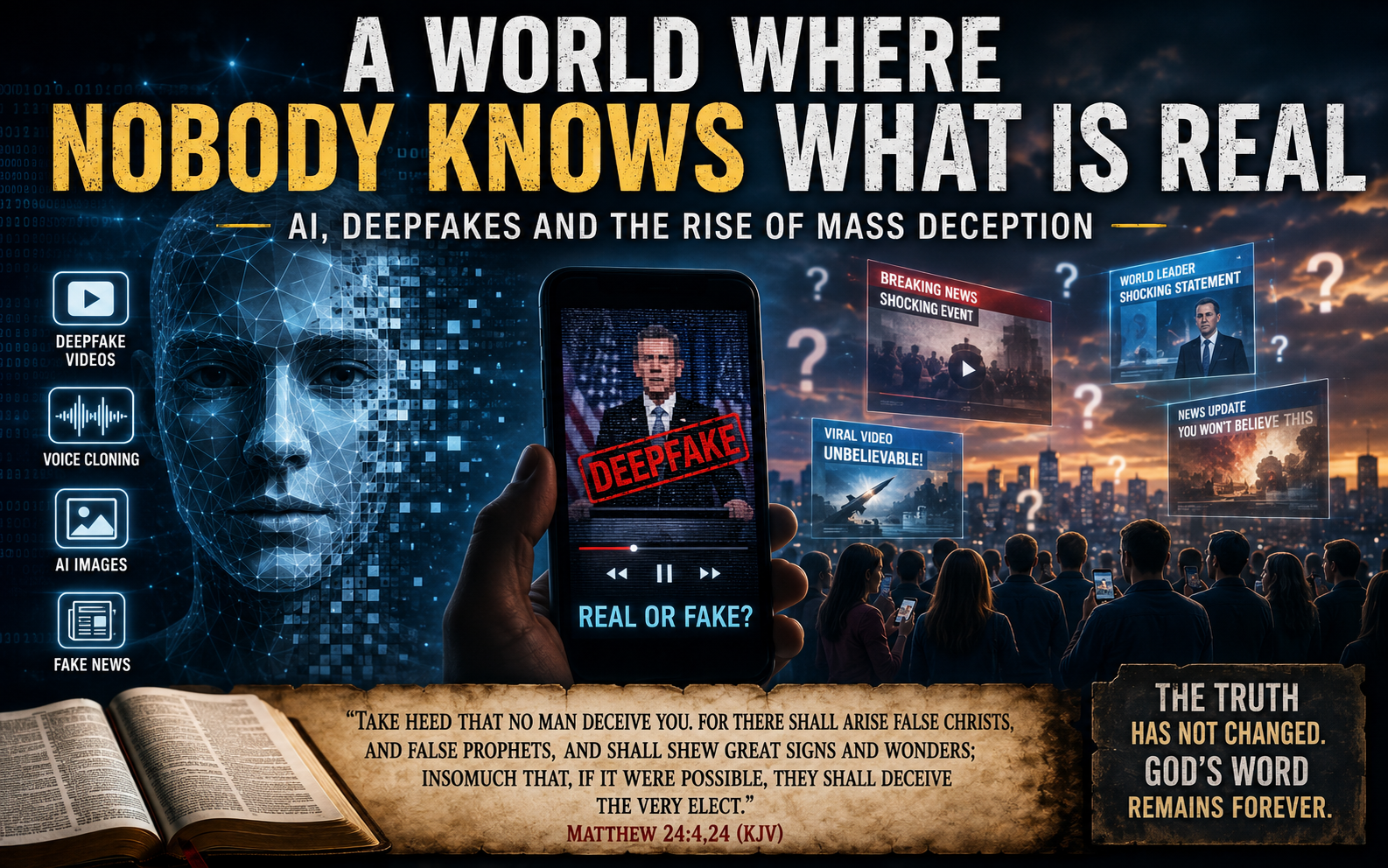
Deepfake technology can place someone’s face into a video, reproduce their voice and make it appear that they said something they never said. AI-generated images can show events that never occurred. Fake news broadcasts can be created with artificial anchors, realistic backgrounds and convincing audio. Some AI-generated videos are still easy to recognize if you look closely, but the technology is improving incredibly fast.
The numbers show just how quickly this is affecting ordinary people. Recent 2026 research found that 85 percent of those surveyed believe scams are now difficult to distinguish from the real thing, compared with 66 percent the previous year. Half reported encountering some form of AI-driven scam, including manipulated images, fake reviews, personalized messages and cloned voices.
We’ve always had lies, propaganda and manipulated photographs. What has changed is the ability to manufacture convincing evidence of the lie itself.
Imagine Hearing the Voice of Someone You Trust
One of the most disturbing developments is AI voice cloning. Imagine answering the telephone and hearing the voice of your son, daughter, mother or friend telling you they’re in trouble and desperately need money. The voice sounds like them. Their tone sounds right. They may even use information about your family gathered from social media.
Except it isn’t them.
People are already encountering these kinds of scams. Recent research found that 16 percent of those surveyed had received a voice-cloned call supposedly from somebody they knew. This is no longer something we’re waiting for technology to become capable of doing. It is already happening.
Now think beyond financial scams. If technology can convincingly reproduce the voice of your family, it can reproduce the voice of a president, religious leader, military commander or almost anyone else. Imagine the confusion that could be created during a war, political crisis or major world event.
Jesus’ First Warning Was About Deception
When When Jesus’ disciples asked Him about the signs of His coming and the end of the world, His first response wasn’t about earthquakes, wars or famine. It was a warning about deception. Matthew 24:4 (KJV Bible) “And Jesus answered and said unto them, Take heed that no man deceive you.” Later in the same chapter Jesus gives an even stronger warning. Matthew 24:24 (KJV Bible) “For there shall arise false Christs, and false prophets, and shall show great signs and wonders; insomuch that, if it were possible, they shall deceive the very elect.” Was Jesus talking about artificial intelligence? AI may be the method used to fulfill these passages, especially when it come to the Mark Of The Beast system. Jesus clearly tells us that extraordinary deception will exist, and our generation is developing tools capable of manufacturing things that previous generations would have considered undeniable proof.
The Greater Danger: What If Nobody Believes Anything?
There is another side to this that may be even more dangerous. AI doesn’t only make it easier to convince people that something fake is real. It also makes it easier to convince people that something real is fake.
Suppose an authentic video exposes corruption, a crime or something extremely important. The person caught on camera can simply say, “That’s AI.” Suppose genuine audio is released of someone saying something terrible. They can claim their voice was cloned. Once society reaches the point where almost anything can be artificially created, real evidence becomes easier to deny.
That could create a world where people stop trusting photographs, videos, recordings, news organizations, governments and eventually one another. The danger isn’t simply believing a lie. The danger is reaching a point where nobody knows what truth looks like anymore.
Governments Are Already Worried About It
This isn’t only something Christians or technology experts are talking about. Governments are beginning to create laws specifically because AI-generated material is becoming difficult to distinguish from authentic content. In August 2026, new European Union transparency requirements took effect requiring certain AI-generated or manipulated material to be marked and requiring deepfakes to be disclosed. The purpose of the rules is specifically to combat deception and manipulation.
In the United States, states have also been passing laws dealing with AI-generated political deepfakes as elections face the possibility of fake candidates, fake voices and fabricated events being circulated online. Meanwhile, scammers are already using deepfake celebrities and politicians to promote fraudulent investments. What was considered futuristic just a few years ago is becoming something governments are trying to regulate today.
Strong Delusion
Another passage Christians often think about when discussing end-time deception is found in 2 Thessalonians.2 Thessalonians 2:9-11 (KJV) describes the coming of the wicked one “after the working of Satan with all power and signs and lying wonders, And with all deceivableness of unrighteousness...” and then says, “And for this cause God shall send them strong delusion, that they should believe a lie.”
Again, I don’t believe we should read the words “lying wonders” and automatically substitute “artificial intelligence.” Scripture describes supernatural spiritual deception, and reducing everything to technology could cause us to miss what the Bible is actually warning about.
But technology could certainly create an environment where deception becomes easier. Humanity is building a world in which false images, voices and events can be manufactured and distributed to millions of people almost instantly.
What Happens During a Global Crisis?
Think about what could happen during a major war or worldwide emergency. A fake video could show a national leader announcing an attack. A cloned military commander could appear to issue an order. A fabricated news broadcast could report something that never happened. Millions of people could see it before anyone had time to prove it was fake.
Now imagine the opposite. A real event occurs, but half the population believes the footage is AI-generated. One group believes the video. Another believes it’s fake. Another believes an entirely different version generated somewhere else.
That kind of environment doesn’t merely spread misinformation. It attacks the very idea that objective truth can be known.
Could AI Play a Role in End-Time Deception?
The honest answer is that the Bible doesn’t tell us. Artificial intelligence could play a role, or the final deception described in Scripture could happen in ways completely different from anything we imagine today.
But I do believe something important has changed. Previous generations worried about propaganda and false witnesses. Our generation has developed technology capable of manufacturing the witness, the photograph, the voice and the video.
For the first time, humanity is approaching a point where almost anything we see on a screen could potentially have been created by a machine.
How Do We Know What Is True?
As this technology becomes more powerful, Christians are going to need something more than a convincing video on social media to determine what they believe. Check sources. Look for confirmation. Don’t immediately share something simply because it frightens you, angers you or confirms something you already believe. Deception works best when it tells us exactly what we want to hear.
Most importantly, stay grounded in Scripture. Technology changes. Governments change. Videos can be manipulated, voices can be cloned and photographs can be manufactured. God’s Word does not change.
Jesus warned us about deception for a reason. Maybe one of the greatest challenges of the generation ahead will not simply be deciding what to believe, but learning how to recognize truth in a world where almost anything can be made to look real.

 E3
E3 
Comments