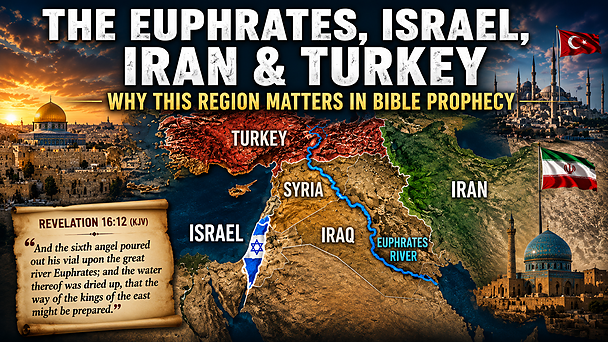
Take a look at a map of the Middle East and then open your Bible. Some of the countries dominating today’s headlines sit in the same region that appears again and again in biblical prophecy. Israel remains at the center, Iran is one of its greatest regional enemies, Turkey is becoming increasingly involved in Syria, and running through this entire area is the Euphrates River, a river that Revelation specifically names in connection with the events leading toward Armageddon.
I’m not saying every military strike, alliance or disagreement we see today is a fulfillment of prophecy. Governments change, alliances change and wars come and go. But when so many countries and locations connected with Scripture continue appearing together in world events, I believe Christians should understand why this particular part of the world matters so much.
Israel Is at the Center
If you study end-time prophecy, it is almost impossible to separate it from Israel and Jerusalem. The prophets repeatedly describe events involving Jerusalem in the last days, and Jesus Himself spoke about future events taking place in Judea and Jerusalem.Zechariah 12:3 (KJV) says, “And in that day will I make Jerusalem a burdensome stone for all people: all that burden themselves with it shall be cut in pieces, though all the people of the earth be gathered together against it.”
Think about how unusual that prophecy is. Jerusalem is a relatively small city in a relatively small country, yet it remains one of the most disputed and closely watched places on Earth. Decisions involving Jerusalem, Gaza, the Temple Mount or Israel’s borders can create reactions thousands of miles away. Whatever someone believes politically about Israel, there is no denying that this tiny piece of land continues to command an extraordinary amount of the world’s attention.
Iran and the Ancient Land of Persia
Modern Iran is particularly interesting to prophecy watchers because ancient Iran was known as Persia. Persia is specifically named in Ezekiel’s prophecy concerning a future coalition of nations coming against Israel.Ezekiel 38:5 (KJV) names “Persia, Ethiopia, and Libya with them; all of them with shield and helmet.”
For much of modern history, Iran and Israel were not enemies. Before Iran’s 1979 Islamic Revolution, the two countries actually maintained significant relations. Today the situation could hardly be more different. Iran and Israel have become bitter enemies, and their conflict has grown from threats and proxy warfare into direct military confrontation.
Does that mean the current Iran-Israel conflict is Ezekiel 38? Not necessarily. There are important details in Ezekiel’s prophecy that should prevent us from simply attaching the chapter to whatever war happens to be taking place today. But Persia being specifically named in a future conflict involving Israel makes modern Iran a country that Bible prophecy watchers understandably keep their eyes on.
Where Does Turkey Fit In?
Turkey creates another interesting connection. Ezekiel 38 names several ancient peoples and territories, including Meshech, Tubal, Gomer and the house of Togarmah. There is disagreement among scholars about precisely how these ancient names should be identified today, so we need to be careful about drawing modern borders around biblical names. However, many prophecy teachers have historically associated at least some of these territories with areas in or around modern-day Turkey and Anatolia.
What makes that especially interesting today is Turkey’s growing involvement in Syria. Turkey supports Syria’s current government and has helped train and rebuild Syrian military forces. At the same time, Israel has become increasingly concerned about a larger Turkish military presence in Syria. In August 2026, Israel struck a Syrian airbase after claiming Syria was preparing to allow Turkish troops to deploy there. Turkey strongly condemned the attack.
That does not make Turkey’s current actions a fulfillment of Ezekiel. But it does mean that Israel and Turkey, two major regional powers, are increasingly finding themselves on opposing sides inside the very region that plays such an important role in biblical history.
Syria Sits Right Between Them
Then there is Syria. Look at the geography and you begin to understand why this region is so important. Syria sits directly northeast of Israel, south of Turkey and west of Iraq. Iran has also exercised enormous influence in Syria over the years. That puts Syria almost directly in the middle of several countries that prophecy watchers have been studying for generations.
Damascus itself is one of the oldest continuously inhabited cities in the world and is specifically mentioned in biblical prophecy. Isaiah 17:1 (KJV) says, “The burden of Damascus. Behold, Damascus is taken away from being a city, and it shall be a ruinous heap.”
Christians disagree about whether Isaiah’s prophecy was completely fulfilled in ancient history or whether there could be a future fulfillment. We shouldn’t pretend that debate doesn’t exist. But once again we find a biblical city sitting directly in the middle of one of the most dangerous geopolitical regions in the world.
Then There Is the Euphrates River
Running through Turkey, Syria and Iraq is another major piece of the prophetic picture: the Euphrates River. The river begins in Turkey, crosses Syria and continues through Iraq. Today those countries have to negotiate over how much water moves downstream, and the entire Tigris-Euphrates basin is facing serious long-term water stress. Recent scientific research has found major reductions in downstream river flow over the past several decades caused by a combination of dams, water use, rising temperatures and declining precipitation.
Then we open Revelation and find this same river specifically named. Revelation 16:12 (KJV) says, “And the sixth angel poured out his vial upon the great river Euphrates; and the water thereof was dried up, that the way of the kings of the east might be prepared.”
The Euphrates is not dried up today, and Revelation describes a specific event during the sixth vial judgment. But we now live in a world where governments control enormous dams on the river and where researchers are documenting major long-term changes in its flow. Something that might have sounded impossible thousands of years ago certainly doesn’t sound impossible anymore.
The Kings of the East
Revelation gives us the reason the Euphrates is dried up: “that the way of the kings of the east might be prepared.” Scripture does not specifically tell us which modern nations make up these kings, so we shouldn’t automatically label China or any other country and claim the Bible specifically names them. What Revelation does tell us is that something involving powerful rulers from east of the Euphrates occurs as the world moves toward the final gathering of nations.
Just a few verses later, Revelation 16:16 (KJV) says, “And he gathered them together into a place called in the Hebrew tongue Armageddon.”
That geographical connection is difficult to ignore. The Euphrates is dried up, the kings of the east are given a way forward, the rulers of the world are gathered, and the chapter ends by directing our attention back toward Israel and Armageddon.
Ancient Names, Modern Nations
This is where prophecy can get dangerous if we aren’t careful. It is tempting to take every ancient biblical name and simply replace it with the name of a modern country. Sometimes there is a strong historical connection, such as Persia and Iran. Other identifications are much more debated.
The important point isn’t to force every modern nation into a particular Bible verse. It is to notice the geography. Israel, Persia, Mesopotamia, Syria, Anatolia and the Euphrates appear throughout Scripture. Thousands of years later, Israel, Iran, Iraq, Syria and Turkey remain some of the most strategically important countries in the Middle East. The names and governments have changed, but much of the geography has not.
Why Is the World Still Focused on This Region?
That may be the most fascinating part of all of this. The Bible was written thousands of years ago, yet the lands it repeatedly draws our attention toward have never disappeared from world history. Israel was restored as a modern nation. Jerusalem remains disputed. Iran and Israel are enemies. Turkey and Israel are increasingly competing for influence in Syria. Syria remains unstable. Iraq sits along the Euphrates, while the river itself faces an uncertain future.
Could all of these events change tomorrow? Of course. Alliances that look permanent today can disappear within a generation. That is why we should never build our faith around newspaper headlines.
But we also shouldn’t ignore geography that Scripture repeatedly tells us will matter. The Bible says Israel and Jerusalem will be important in the last days. It names Persia. It describes nations gathering for war. It specifically names the Euphrates and says the river will one day be dried up.
Today, we can open a Bible in one hand and a map of the Middle East in the other and recognize many of the same places.
Are We Watching the Prophetic Stage Being Set?
I don’t know if the conflicts we’re watching today will directly become the wars described in Bible prophecy. Nobody does. The current leaders could disappear, governments could fall and alliances could completely change before these prophecies are fulfilled.
But something about the bigger picture is difficult to dismiss. Israel is back in the land. Jerusalem is once again at the center of international controversy. Persia, modern Iran, is one of Israel’s greatest enemies. Turkey is becoming increasingly involved in Syria. The Euphrates is under growing pressure. And the entire region continues moving through wars, alliances and confrontations that can change almost overnight.
Maybe we’re simply watching another chapter in the long and violent history of the Middle East. Or maybe some of the pieces that will eventually be involved in biblical prophecy are slowly moving into position.
We shouldn’t set dates, and we shouldn’t claim more than Scripture actually tells us. But Jesus did tell us to watch. And right now, this is one part of the world I believe is worth watching very closely.

 E2
E2 
Comments