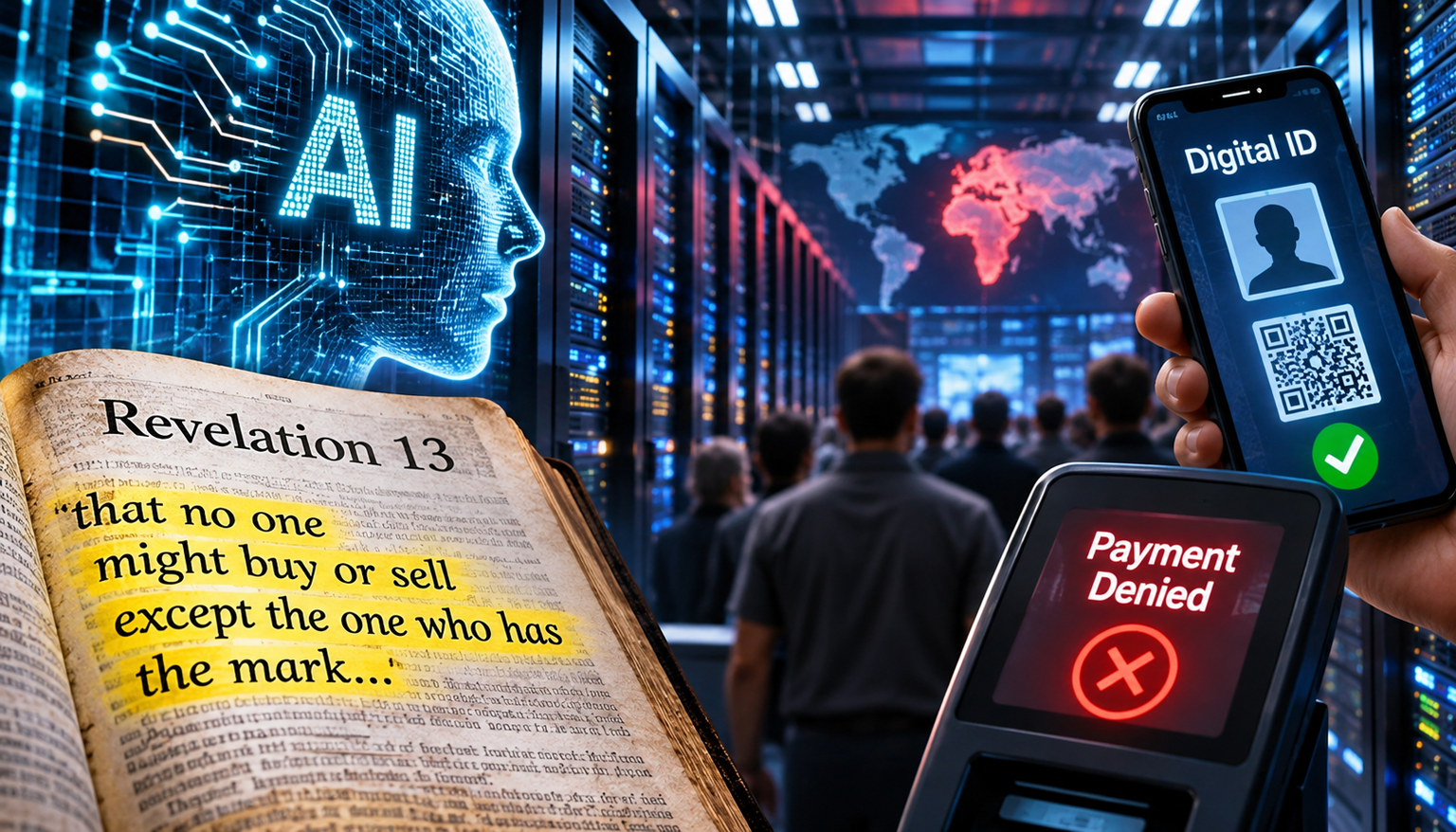
Revelation 13 — “16. And the second beast required all people, small and great, rich and poor, free and slave, to receive a mark on their right hand or on their forehead, 17. so that no one could buy or sell unless he had the mark—the name of the beast or the number of its name.18. Here is a call for wisdom: Let the one who has insight calculate the number of the beast, for it is the number of a man, and that number is 666”
E10
A Warning Written Nearly 2,000 Years Ago
Almost two thousand years ago, the apostle John recorded a prophecy describing a future system of extraordinary economic control.
Revelation 13:16–17 states that people, regardless of wealth or social position, would be required to receive the mark of the beast, and that those without it would be unable to buy or sell.
For centuries, Christians have debated how such a system could operate across entire populations.
Today, the rapid expansion of artificial intelligence, enormous data centers, digital identity systems, and increasingly automated financial networks raises a significant question:
Could modern technology eventually provide the infrastructure for the economic control described in Revelation?
technological developments make it possible to examine how restrictions on financial participation could be implemented on a scale that previous generations could scarcely imagine..
Why AI Data Centers Matter
Artificial intelligence depends on vast computing infrastructure. Large data centers house the processors, storage systems, and networking equipment that allow advanced AI models to analyze information and perform complex tasks.
These facilities can support everything from medical research to cybersecurity, transportation, government services, and banking.
However, the same technology that helps institutions process enormous amounts of information could also be used to monitor financial activity, verify identities, detect transactions, and apply access restrictions.
A data center itself cannot decide who is permitted to buy groceries or maintain a bank account. That would require payment networks, identity systems, institutional policies, and legal or other enforcement mechanisms.
But when these technologies are connected, they could provide the foundation for a highly automated system of economic control.
Artificial Intelligence Is Already Entering the Financial System
In September 2026, the International Monetary Fund published a policy discussion titled AI and the Future of Payments Policy.
The IMF described how artificial intelligence could automate transactions, improve sanctions screening, support regulatory monitoring, and coordinate payments between machines and financial institutions.
An earlier IMF analysis, published in April 2026, examined how autonomous AI agents might initiate and manage financial transactions with limited human intervention.
These are significant developments.
They demonstrate that AI is no longer limited to answering questions or generating images. It is increasingly being considered for participation in the systems through which money moves.
Such technology has legitimate benefits, including fraud prevention, faster payments, and improved financial services. Yet it also raises questions about accountability, privacy, and the possibility of wrongful exclusion.
Digital Identity: The Key to Financial Access?
A digital identity system allows a person to prove who they are electronically.
Digital identification can make banking more convenient, reduce identity theft, and help people access essential services.
But consider a possible future in which every significant financial transaction requires an approved digital identity.
If access to that identity were suspended, restricted, or made conditional on compliance with certain requirements, an individual might face difficulties participating in ordinary economic life.
That possibility is not proof of an emerging biblical mark. It is a question about how financial access could be controlled if identity and payment systems became sufficiently interconnected.
Research published by the Bank for International Settlements has examined the privacy implications of digital payment ledgers, particularly when large technology companies or centralized platforms control important financial infrastructure.
The central concern is not digital identity alone. It is the potential concentration of power over identity, information, and access to money.
Could a Cashless Society Make Economic Control Easier?
Cash has an important characteristic: ordinary cash transactions can occur without a computer system approving every purchase.
Digital transactions generally depend on payment providers, accounts, software, and communications networks.
If physical cash became difficult to use and most purchases required electronically authorized payments, restrictions imposed through those networks could become more consequential.
A sufficiently centralized system might technically be capable of rejecting payments, limiting accounts, or preventing particular users from completing transactions.
That does not mean every digital currency or cashless payment system is designed for such purposes.
It does mean that the structure, ownership, privacy protections, and governance of future payment systems deserve serious scrutiny.
What Does Revelation Actually Say?
Revelation 13 does more than describe an economic restriction.
The chapter connects the mark of the beast with the authority of the beast and a wider system involving worship and allegiance.
That distinction matters.
The biblical passage does not simply warn about a new method of payment. It describes a system in which economic participation becomes connected to submission to an authority opposed to God.
Christians interpret the timing and fulfillment of this prophecy differently. Some understand it primarily in relation to the Roman Empire, while others anticipate a future worldwide system.
For those who hold a futurist interpretation, modern digital infrastructure presents a possible means by which the prophecy's economic restrictions could be enforced.
The Real Question: Who Controls the System?
Artificial intelligence is not inherently the beast described in Revelation.
Neither is a data center, smartphone, credit card, or digital wallet.
The deeper issue is what could happen if powerful institutions acquired the ability to combine identification, financial access, automated surveillance, and economic restrictions.
Could people be denied essential transactions because they refused a required form of allegiance?
Could access to ordinary commerce become dependent on accepting conditions imposed by a powerful governing authority?
Those questions closely resemble the economic consequences described in Revelation 13, current technology can definitely become the fulfillment of that prophecy.
A Reason for Watchfulness, Not Fear
The Bible encourages believers to remain spiritually watchful.
That does not require treating every new invention as evidence that the end times have arrived.
Technology can be used for good or for harm. Artificial intelligence can help people, improve services, and solve difficult problems. The same infrastructure can also create opportunities for surveillance, concentration of power, and misuse.
The challenge is to recognize both realities.
The most significant development may not be AI itself, but the increasing ability to connect digital identity, automated decision-making, and financial access within the same technological infrastructure.
Revelation 13 presents a warning about economic coercion and allegiance. Modern technology provides a reason to examine how such coercion might become possible, without claiming that it has already fulfilled the prophecy.
For Christians studying biblical prophecy, the appropriate response is discernment: follow verified developments, distinguish evidence from speculation, and remain faithful to the message of Scripture.

 E10

Comments