1. Could Artificial Intelligence Be the Image of the Beast?
For nearly two thousand years, readers of the Book of Revelation have wondered what John meant when he described an image that would be given breath, speak, and become the focus of enforced worship. In the first century, there were no computers, microchips, satellites, or artificial intelligence. Today, however, machines can generate lifelike faces, imitate voices, answer questions, and appear to interact with people in real time. Could this technology eventually play a role in the events described in Revelation 13?
The similarities are intriguing, but a similarity is not proof of fulfillment. To explore the possibility responsibly, we need to separate what Scripture explicitly says from what modern technology might make possible.
2. What Does Revelation Actually Say About the Image?
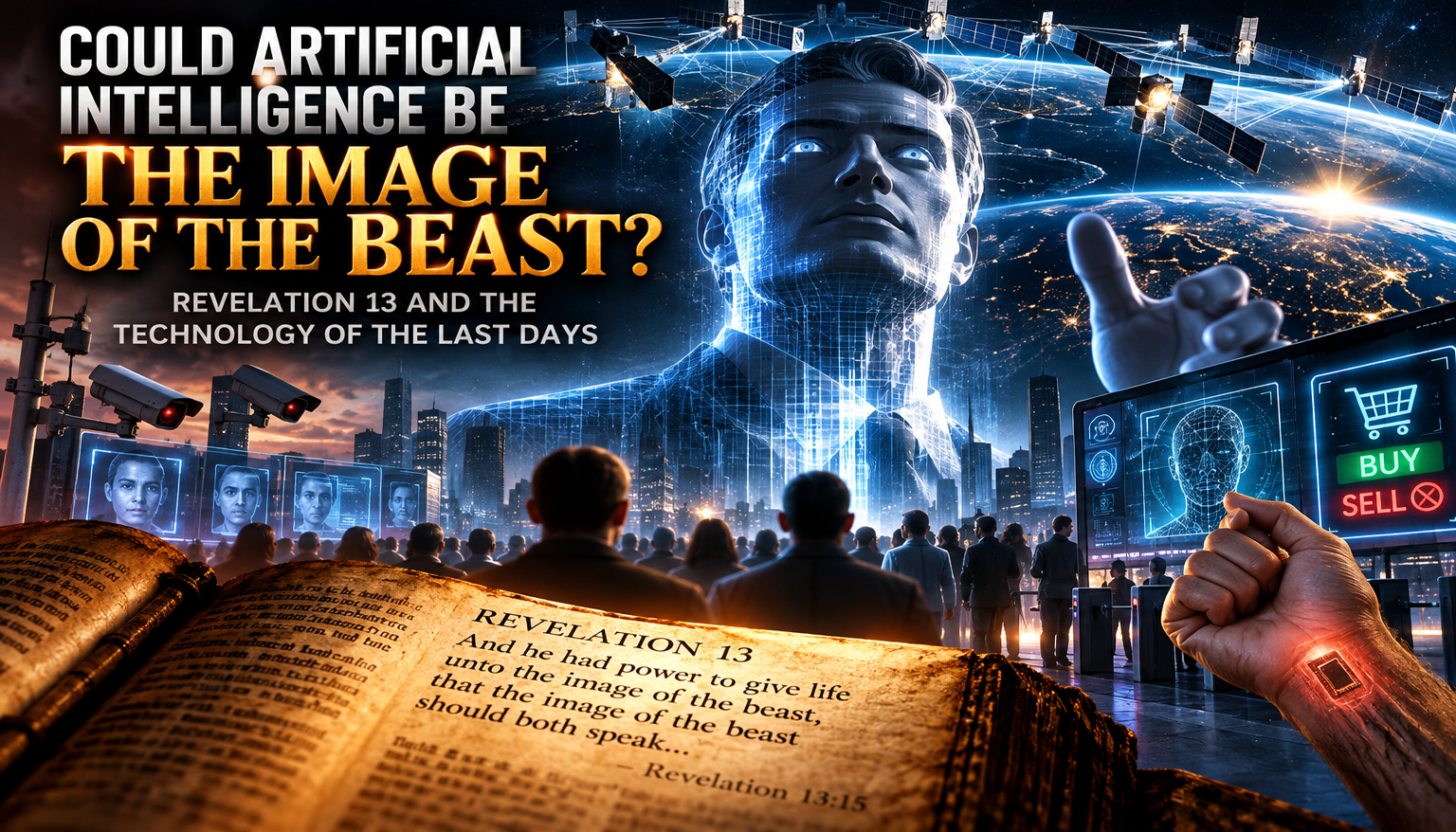
Revelation 13:14 describes the second beast deceiving the inhabitants of the earth and telling them to make an image of the first beast. Then Revelation 13:15 states, in the King James Version: “And he had power to give life unto the image of the beast, that the image of the beast should both speak, and cause that as many as would not worship the image of the beast should be killed.”
Notice the sequence. An image is made. It is given something described as life or breath. It speaks. And it becomes associated with a demand for worship backed by the threat of death. The passage does not describe the image's materials, construction, or technology. It does, however, emphasize its religious and political significance.
3. Who Gives Breath to the Image of the Beast?
According to Revelation 13, it is the second beast that is permitted to give breath to the image of the first beast. Revelation 13:2 says the dragon gives authority to the first beast. The second beast then exercises authority on behalf of the first, performs deceptive signs, and directs people to make its image. Revelation 19:20 describes a false prophet who performs signs in the beast's presence, which is why many interpreters identify the second beast with the false prophet.
The Greek word translated as “life” in the King James Version is pneuma, a word that can mean breath, spirit, or wind depending on context. Some Christians understand this as a supernatural animation of an image. Others wonder whether the description could encompass something that appears alive without being biologically living. The text itself does not settle the question of whether a future image would involve machinery, a miracle, or symbolic language.
4. Why Artificial Intelligence Raises a New Question
Artificial intelligence can already create realistic digital humans, synthesize speech, imitate recognizable voices, and conduct conversations. A screen-based figure may look directly at a viewer, respond to spoken questions, and appear to possess a personality. Robotics could add physical movement. None of this makes a machine a living human being, but it does show how an image can appear animated and speak.
Could a future authority use an AI-generated representation of a political or religious leader as a powerful symbol of allegiance? Technologically, that is conceivable. Whether it is what John saw is another matter. Revelation never names artificial intelligence, and the central issue in the passage is not technological sophistication but worship, deception, and coercion.
5. How Would John Describe Technology He Had Never Seen?
John lived in a world of statues, imperial images, temples, and public displays of loyalty. He did not have words for computer processors, digital networks, or interactive holograms. If he had witnessed something resembling a speaking artificial figure, it is reasonable to ask whether he might have described it as an image given breath.
Yet we should also consider the historical setting. Images of rulers and deities already represented power and worship in the Roman world. John's vision may draw on those familiar realities to warn against idolatry and oppressive authority. A futuristic reading is one interpretation, not the only one.
6. Could AI Help Enforce the Mark of the Beast?
Revelation 13:16–17 describes a mark associated with the beast and says that no one can buy or sell without the mark, the beast's name, or the number of its name. The text does not say that the mark is a microchip, biometric identifier, or digital account. But modern systems show how identification and financial access can become interconnected.
Imagine a hypothetical system combining digital identity, facial recognition, AI-assisted monitoring, and electronic payments. If a powerful authority controlled participation, it could potentially deny transactions to people who refused its requirements. Such a system would resemble the economic exclusion described in Revelation. That does not mean today's digital payment services or identification tools are themselves the mark of the beast.
7. Where Do Satellites and Space-Based AI Fit In?
The rapid expansion of AI requires enormous computing resources and substantial electrical power. Proposals for orbital computing infrastructure, including plans associated with Elon Musk and SpaceX, have raised the possibility of using solar power in space to support AI processing. These are ambitious proposals, not proof that a fully functioning global orbital AI network already exists.
Space offers access to sunlight, but it also creates difficult engineering problems. Electronics still produce waste heat, and the vacuum of space prevents ordinary air cooling. Large radiators would be needed to release heat through radiation. Launch costs, maintenance, communications, and orbital congestion are additional challenges.
If space-based computing eventually becomes practical, it might expand the reach and capacity of AI services. But Revelation does not mention satellites, and an economic-control system would not require them. Ground-based networks could already provide many of the relevant capabilities.
8. The Image and the Mark May Serve Different Purposes
One possibility worth examining is that the image and the mark are not the same thing. In Revelation 13, the image is associated with speech and compulsory worship, while the mark is associated with identity, allegiance, and access to commerce. A future artificial image, if that interpretation were correct, might function as a public representation of authority. A separate system might enforce compliance through economic restrictions.
This is a hypothetical model, not an established interpretation. Its value is that it keeps the details of the passage distinct instead of assuming that one invention must explain every part of the prophecy.
9. What About UFO Disclosure and an Alien-Deception Scenario?
Some Christians speculate that future claims about extraterrestrial intelligence could be used to reshape religious beliefs or influence humanity on a global scale. AI-generated images and videos could make deceptive presentations more convincing. That makes media literacy and careful verification increasingly important.
However, released UFO records, unidentified sightings, and public discussion of extraterrestrial life do not establish that a staged alien event is planned. Revelation 13 does not specifically describe aliens. Any proposed connection should be identified as speculation rather than presented as a confirmed biblical prediction.
10. Could Prophecy Become Self-Fulfilling?
Skeptics sometimes argue that a prophecy can appear fulfilled when later generations know the text and deliberately act in ways that resemble it. That is a genuine possibility in principle. If someone copies an ancient prediction, the resemblance alone does not prove supernatural foreknowledge.
Believers may answer that God could know in advance even the decisions people would freely make. These are different explanations of the relationship between prophecy, human choice, and history. Rather than dismissing the question, it is worth asking what evidence would distinguish deliberate imitation from genuine fulfillment.
11. The Most Important Warning Is About Worship, Not Technology
It is tempting to identify every major technological breakthrough with a specific verse in Revelation. But the biblical warning runs deeper than the existence of machines. Revelation 13 describes deception, misplaced worship, and the use of power to demand allegiance. Technology could become a tool of such power, but it is not automatically evil simply because it is advanced.
The challenge for Christians is to remain faithful and discerning without turning every headline into a declaration that prophecy has been fulfilled. For readers who do not share the Christian faith, the same discussion raises important questions about concentrated power, freedom of conscience, surveillance, and the right to participate in society.
12. Final Thoughts: A Speaking Image in an Age of AI
Could artificial intelligence be involved in the image of the beast? It is a possibility worth examining, particularly as AI-generated figures become more realistic and digital systems become more interconnected. Yet Scripture does not explicitly identify AI as the image, and no present-day technology has been demonstrated to fulfill the complete description in Revelation 13.
Perhaps the most revealing question is not simply whether a machine can speak, but who controls it, what it asks people to believe, and whether participation in ordinary life could someday be made conditional on allegiance to an authority. Those questions deserve serious attention regardless of one's interpretation of Bible prophecy.
For now, the wisest approach is to watch developments carefully, examine the evidence, and read the biblical text in its full context. Technology may change rapidly. The responsibility to seek truth, resist deception, and respect human conscience remains.

 E9

Comments