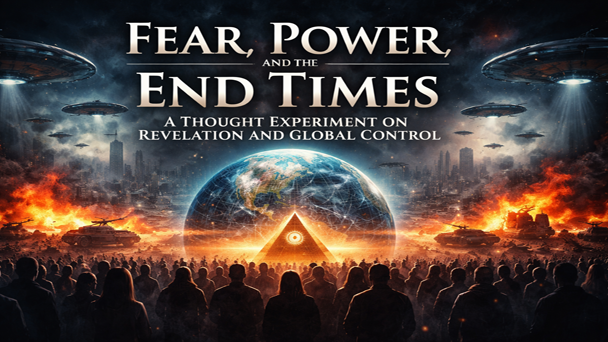
A Thought Experiment on Revelation and Global Control
D11
Throughout history, fear has been one of the most effective tools for consolidating power. This article does not claim that a specific event—such as a staged alien invasion—is planned or factual. Instead, it explores a hypothetical thought experiment: if global elites wanted to usher in a one-world government, one-world economy, and unified belief system, what kind of scenario would realistically make that possible, and how does that align with the warnings found in the Book of Revelation?
Why Fear Has Always Worked
Fear bypasses logic and accelerates compliance. Historically, moments of widespread fear—wars, terrorism, and global emergencies—have led populations to accept centralized authority, suspended rights, and sweeping changes that would otherwise be rejected. This pattern is documented and repeatable, regardless of era or ideology.
Revelation repeatedly speaks in global terms: “all nations,” “the whole world,” and “every tribe and tongue.” A crisis that affects the entire planet simultaneously is one of the few mechanisms capable of producing that level of unified response.
A Hypothetical Global Threat Scenario
In theory, a perceived non-human or external threat—real or not—would instantly dissolve national boundaries. No single country could claim authority or defense capability on its own. Under those conditions, sovereignty would be viewed as an obstacle rather than a protection.
Importantly, the Book of Revelation does not require extraterrestrials to fulfill its prophecies. It only requires a force that humanity perceives as beyond its ability to control, creating dependence on centralized leadership.
The Rise of a “Solution” Authority
Fear alone cannot sustain control. For power to endure, people must believe that someone—or something—can resolve the crisis. Revelation describes a figure who does not rise merely through violence, but through solutions, order, and promises of peace.
In a hypothetical scenario, nations would voluntarily surrender authority “temporarily” in exchange for safety. History shows that emergency powers, once granted, are rarely fully returned.
Economic Control and One Currency
Revelation is most explicit when it comes to economic control. The inability to buy or sell without compliance implies a centralized system capable of monitoring and restricting transactions. A global crisis would provide the justification for a unified digital or centralized economic structure in the name of stability and security.
This does not require overt tyranny at first. Economic systems are often accepted willingly when framed as necessary for survival or fairness.
The Idea of One Religion
Revelation does not describe a sudden elimination of all belief systems in favor of a single traditional religion. Instead, it describes worship directed toward power, authority, and the system itself. Allegiance becomes spiritual, even if it is not labeled as such.
In this sense, the “religion” of the end times may not involve temples or rituals, but loyalty to the system that claims to have saved humanity.
Normalization and Desensitization
Governments and institutions often release disruptive information gradually to avoid public shock. This process of normalization does not prove malicious intent, but it does condition societies to accept ideas that once seemed impossible. Familiarity reduces resistance.
What Revelation Is Really Warning About
The Book of Revelation is not primarily about predicting technological details or specific events. It is a warning against absolute power, economic coercion, and enforced allegiance. Its message is less about how evil succeeds and more about how deception ultimately fails.
Rather than asking whether a specific scenario is planned, the more enduring question is what conditions cause people to surrender freedom, conscience, and truth. That question applies to every generation.

 D11
D11 
Comments