1. The Book of Revelation: More Than an End-Time Timeline
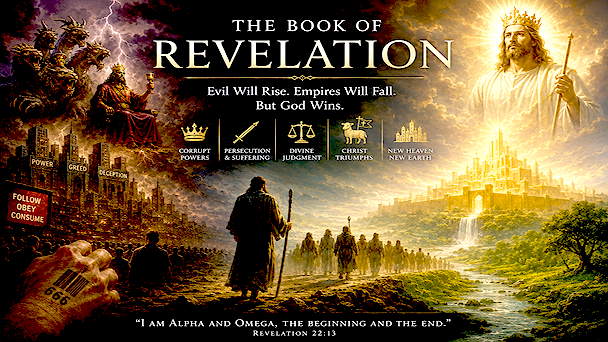
The Book of Revelation has often been treated as a mysterious puzzle book, a coded warning about future disasters, political leaders, or global catastrophe. For centuries, people have searched its pages trying to match its symbols to current events, empires, wars, or religious movements. Yet when Revelation is examined as a whole, its deeper purpose appears far greater than merely predicting isolated future headlines. At its core, Revelation is a sweeping spiritual vision about humanity, power, corruption, judgment, endurance, and the final triumph of God over evil.
Rather than functioning solely as a chronological roadmap of destruction, Revelation reveals the recurring pattern of what happens when societies reject truth, worship power, and build systems rooted in greed, oppression, and deception. It is both a warning and a promise: a warning that corruption will rise, and a promise that it will not last forever.
2. Revelation’s Central Message: The Battle Between Corrupt Power and Divine Authority
One of the clearest themes throughout Revelation is the contrast between earthly power and God’s eternal kingdom. The “Beast,” “Babylon,” and the “False Prophet” are often understood not simply as individual figures, but as symbols of larger systems—political, economic, and spiritual powers that oppose truth and demand allegiance.
Babylon, for example, can be seen as representing civilizations built on excess, exploitation, immorality, and the pursuit of wealth at the expense of righteousness. The Beast often symbolizes oppressive authority that seeks worship, obedience, and control beyond what belongs to God. These symbols transcend one nation or one era; they represent patterns that can emerge throughout history whenever power becomes corrupt.
3. The Saints and the Call to Endure
Revelation repeatedly emphasizes the endurance of the saints. This is not merely about surviving physical persecution, though suffering is certainly present. It is also about resisting deception, compromise, fear, and spiritual surrender. The faithful are called to remain steadfast when surrounded by systems designed to pressure them into conformity.
In this sense, Revelation speaks not only to one future generation, but to all generations. Every age faces its own temptations—whether political manipulation, moral compromise, materialism, or spiritual confusion. Revelation’s call is consistent: remain faithful even when the world appears dominated by darkness.
4. The Mark of the Beast: Symbol of Allegiance
Few symbols in Revelation have caused more fear than the Mark of the Beast. While interpretations vary, many scholars and theologians view it not simply as a physical mark, but as a symbol of allegiance—an outward and inward commitment to corrupt systems over divine truth.
This interpretation shifts the focus from fear-driven speculation to spiritual examination. The deeper question may not merely be “What is the mark?” but rather “What do people ultimately serve?” Revelation continually points toward worship, loyalty, and identity.
5. Judgment Is Not Random Destruction
The judgments described through seals, trumpets, and bowls are often read as terrifying punishments, but they also reveal accountability. Revelation portrays a universe in which evil is not ignored forever. Corrupt empires, injustice, violence, exploitation, and rebellion eventually face consequences.
This is essential to understanding Revelation: it is not chaos without meaning. It is judgment with purpose. The destruction of evil clears the way for restoration.
6. The Fall of Babylon: The Collapse of Corrupt Civilization
Babylon’s fall is one of Revelation’s most powerful images because it represents the eventual collapse of systems that appear invincible. Wealth, luxury, political might, and cultural dominance cannot shield corruption forever. Revelation warns that societies built on exploitation eventually fall under the weight of divine justice.
This theme has resonated throughout history because every empire, no matter how powerful, is temporary. Revelation reminds readers that no earthly kingdom is ultimate.
7. Armageddon and the Final Defeat of Evil
Armageddon is often sensationalized as merely a catastrophic war, but symbolically it represents the final confrontation between rebellion and divine authority. It is the climax of humanity’s resistance against God—and the certainty that such rebellion will fail.
The final message is not that evil nearly wins forever, but that evil’s apparent power is temporary. God’s sovereignty remains supreme.
8. The New Heaven, New Earth, and New Jerusalem
Revelation does not end in destruction—it ends in renewal. After judgment comes restoration. The New Jerusalem symbolizes God dwelling with humanity, the removal of suffering, the end of death, and the healing of creation.
This final vision transforms Revelation from a book of fear into a book of hope. Its ultimate purpose is not to terrify believers, but to assure them that injustice, corruption, and suffering do not have the final word.
9. Revelation’s Enduring Warning for Every Generation
Perhaps the greatest misunderstanding of Revelation is limiting it to one era alone. Its symbols are powerful precisely because they describe recurring truths. Whenever societies worship power, normalize deception, exploit the vulnerable, or replace truth with control, the spirit of Babylon and the Beast can be seen.
This makes Revelation timeless. It is not merely about “the end,” but about the spiritual realities present throughout history until the final restoration.
10. Final Thought: Revelation Is Ultimately About Hope
In the end, the Book of Revelation is a divine declaration that evil is real, corruption rises, deception spreads, and suffering comes—but none of these are permanent. Empires fall. False powers collapse. Judgment comes. God remains.
Its message is both sobering and comforting: endure, remain faithful, resist deception, and remember that no matter how dark history becomes, evil does not write the final chapter. According to Revelation, the end belongs not to chaos, but to justice, restoration, and the eternal reign of God.

 D38
D38 
Comments