Many Christians assume Sunday worship is commanded in the Bible. However, when examined historically and doctrinally, Sunday observance is rooted not in Scripture, but in church authority — a fact openly acknowledged by the Catholic Church itself.
The Bible Never Commands Sunday as the Sabbath
As shown in Scripture, the Sabbath is the seventh day of the week — Saturday — established at creation and reaffirmed in the Ten Commandments. Nowhere does the Bible transfer the holiness of the Sabbath from Saturday to Sunday.
Because of this, the question naturally arises: if the Bible does not command Sunday observance, where did it come from?
The Catholic Church’s Own Explanation
The Catholic Church does not claim that Sunday observance comes from Scripture alone. Instead, it teaches that the Church has authority to define sacred practices.
This is stated plainly in Catholic teaching materials. In The Convert’s Catechism of Catholic Doctrine, the following exchange appears:
Q: Which is the Sabbath day? A: Saturday is the Sabbath day.
Q: Why do we observe Sunday instead of Saturday? A: Because the Catholic Church transferred the solemnity from Saturday to Sunday.
“Sunday Is Our Mark of Authority”
One of the most direct admissions comes from The Catholic Record (London, September 1, 1923), which stated:
“Sunday is our mark of authority… The Church is above the Bible, and this transference of Sabbath observance is proof of that fact.”
This statement highlights the core issue: Sunday observance is based on church authority, not a biblical command.
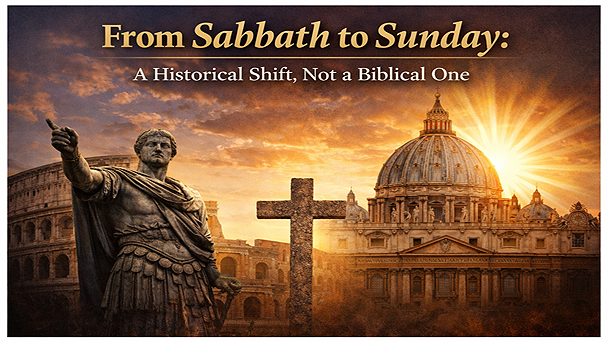
The Role of Constantine and Roman Influence
In A.D. 321, Roman Emperor Constantine issued a civil decree declaring Sunday a legal day of rest:
“On the venerable Day of the Sun let the magistrates and people residing in cities rest…”
This decree was political, not biblical. It aligned Christianity with existing Roman sun worship customs and laid the groundwork for the Church to later formalize Sunday observance.
The Council of Laodicea: A Clear Policy Shift
Around A.D. 363–364, the Council of Laodicea issued a ruling discouraging Sabbath observance and promoting Sunday instead:
“Christians shall not Judaize and be idle on Saturday, but shall work on that day; but the Lord’s Day they shall especially honor…”
This was not a change based on Scripture, but a deliberate move away from biblical Sabbath observance.
Authority vs. Scripture
At its core, the issue is not about sincerity or personal faith, but authority:
• The Bible identifies the Sabbath as Saturday
• Sunday observance developed through church tradition
• The Catholic Church openly acknowledges its role in the change
Conclusion
The shift from Saturday to Sunday did not occur by a command from God, but through historical, political, and ecclesiastical decisions. This fact is not hidden — it is acknowledged by the very institution that made the change.

 D15
D15 
Comments