
Watch video Above
The Vatican's Dark Secrets
 B17
B17 
What you’re about to hear isn’t an attack on the Catholic faith—it’s about the hidden power and mystery of the Vatican itself. It's seems corruption has its hands in everything and everyone.
The Vatican, a beacon of spiritual guidance for over a billion Catholics, has long been shrouded in mystery and intrigued, along with whispers of corruption and darkness buried within its walls and secrets far more unsettling than most dare to imagine. The Bible warns us of the Antichrist and the false prophet who will rise and work together. Many believe, and I am one of them, that the false prophet will come from the papacy itself.
1. Financial Scandals and Corruption
The Vatican's financial institutions have been embroiled in numerous scandals over the decades. The Institute for the Works of Religion (IOR), commonly known as the Vatican Bank, has faced allegations of money laundering and financial mismanagement. In 2010, Italian authorities seized €23 million from the IOR due to violations of anti-money laundering laws, though the funds were later released after the Vatican took steps to conform to international standards.
Further compounding the financial woes, former Vatican auditor-general Libero Milone revealed a €2.5 million donation intended for a hospital ward that never materialized—only a plaque was found. Milone claims this case is just "the tip of the iceberg," pointing to systemic money laundering within the Vatican’s asset manager, APSA.
2. Espionage and Covert Operations
The Vatican's secretive intelligence service, known as "The Entity," has a history of espionage dating back to the 16th century. This shadow agency conducted operations to destabilize communist regimes, often in cooperation with Western intelligence agencies like the CIA and MI6. Notably, the Russicum program trained priests in espionage skills to infiltrate the USSR.
3. The Disappearance of Emanuela Orlandi
In 1983, 15-year-old Emanuela Orlandi vanished without a trace, sparking widespread speculation and conspiracy theories. Some claim she was abducted by a member of the Vatican police for sex parties, while others suggest she was taken by the Banda della Magliana, a notorious Roman gang, at the behest of someone inside the Vatican to cover up a sex scandal.
4. The Vatileaks Scandal
In 2012, a significant leak of confidential Vatican documents, known as the "Vatileaks" scandal, exposed internal corruption and power struggles. The documents revealed that Archbishop Carlo Maria Viganò had warned the Vatican about corruption in finances and defamation campaigns against him. The leaks led to the conviction of Pope Benedict XVI's butler, Paolo Gabriele, for stealing and disseminating the documents.
5. Allegations of Occult Practices
Father Gabriele Amorth, the Vatican's chief exorcist for over 60 years, claimed that Satanic rituals and occult practices were not just relics of the past but continued within the Church. He alleged that some high-ranking officials were involved in such activities, though these claims remain unsubstantiated.
6. Sexual Abuse Cover-Ups
The Catholic Church has faced numerous allegations of sexual abuse by clergy members. Critics argue that the Vatican's Congregation for the Doctrine of the Faith handled these cases with secrecy, often delaying justice. Some have likened this approach to the Mafia's code of silence, known as "omertà," suggesting a systemic effort to conceal the abuse and protect perpetrators.
Conclusion
The Vatican has long stood as a symbol of faith, unity, and spiritual authority, but the shadows within its walls tell a different story—one of power, corruption, and secrecy. From financial scandals and espionage to abuse cover-ups and occult allegations, these accounts reveal a darker side often hidden from public view. For many, these revelations serve as a reminder that even institutions claiming divine authority are not immune to deception and sin. In light of biblical prophecy, such corruption within religious power structures may foreshadow the spiritual deception of the end times. The question remains: will the truth continue to be unveiled, or will these shadows deepen in the days ahead?
The Paul VI Audience Hall
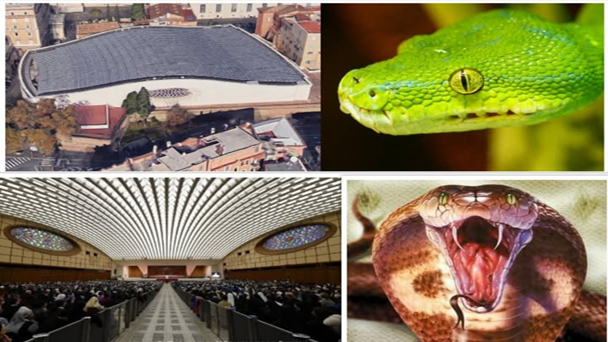
Inside the Vatican stands the Paul VI Audience Hall, also known as Aula Paolo VI, completed in 1971 and designed by Italian architect Pier Luigi Nervi. The massive hall holds over 6,000 people and is used for papal audiences when St. Peter’s Square cannot be used. Its design, however, has stirred controversy due to its serpent-like appearance.
1. The Serpent-Like Appearance
From certain angles, the inside of the hall resembles the head of a serpent. Two large windows on each side of the stage appear like piercing eyes, the stage backdrop resembles fangs, and the curved walls and ceiling give the impression of scales. When photographed with wide-angle or fisheye lenses, the resemblance becomes even more striking, fueling speculation of hidden symbolism.
2. The Sculpture: La Resurrezione
Behind the stage sits a massive bronze sculpture called La Resurrezione (“The Resurrection”), created by artist Pericle Fazzini in 1977. The chaotic, jagged piece was meant to show Christ rising from a nuclear-like explosion in the Garden of Gethsemane. Critics, however, say the disturbing imagery adds to the hall’s sinister appearance, reinforcing the serpent comparison.
3. Aerial View of the Hall
Even from above, the Paul VI Hall adds to the speculation. Its curved roofline, designed with Nervi’s thin-shell concrete engineering, has been compared to the head of a serpent when viewed from certain angles. In 2008, the roof was fitted with 2,400 solar panels, which only highlighted the scale-like patterns of its structure. While architects call it a masterpiece of modernist design, others see darker meaning in its shape.
4. Symbolism or Coincidence?
The Vatican has never admitted to any serpent symbolism in the building’s design, and mainstream sources describe it simply as Nervi’s modernist engineering combined with Fazzini’s bold artistic vision. Yet for many observers, the resemblance is undeniable—raising questions about whether the design was a coincidence or a reflection of deeper symbolism hidden in plain sight.
Images of the Serpent-Like Hall
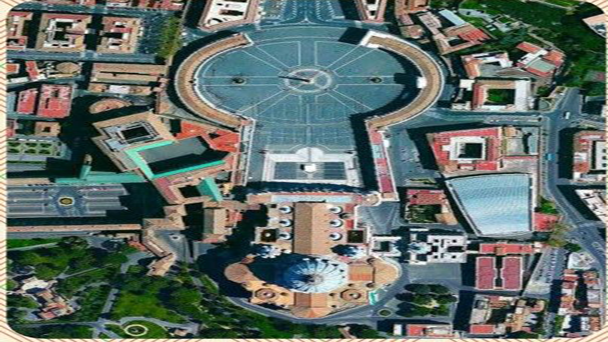
Images that highlight the serpent-like features of the Paul VI Audience Hall
Featured Videos 1 - 5
-
2. Glenn Beck: My visit to Vatican City proves EVIL IS EVERYWHERE
-
5. How Vatican City’s DARK SECRETS are relevant to YOU
Comments